Subscribe to our RSS Feeds

Supreme Commander 2

2 Comments »

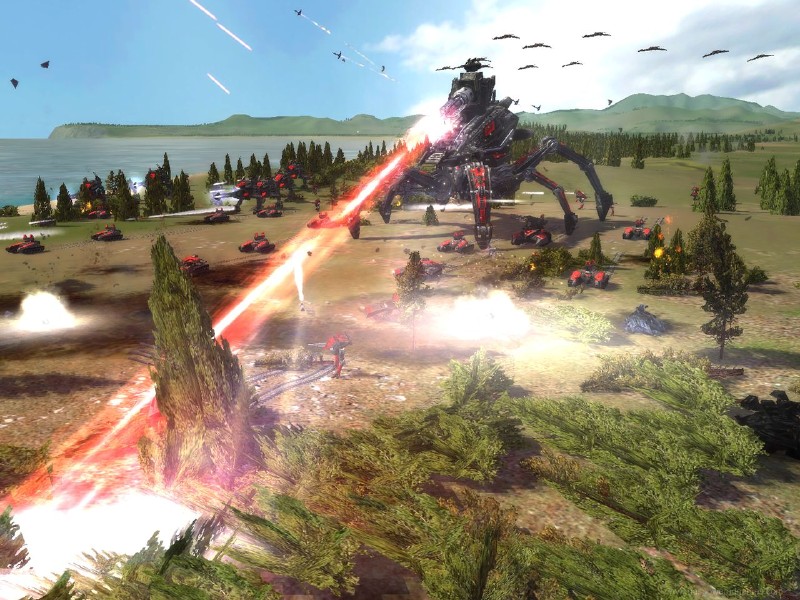
August 19, 2009 - Giant explosions and the culmination of a set of decisions made to best manage a complex tug-of-war resource system is part of what made Gas Powered Games' Supreme Commander so great. Hopefully the same sort of thing could be said about the sequel, which I had a chance to play at the Square-Enix booth at Gamescom 2009. While in many ways the game felt familiar, there were also quite a few areas of the tech trees that proved to be quite different.

Many things from the original are still there. You still control a gigantic robot to build your initial base. You can still queue up build orders when setting down mass extractors, generators, and land factories to fuel production of and build units. It's still possible to zoom way out until you can see the entire map, though in this case the map was rather small, resembling more of a Demigod map than something out of the original game. When you're zoomed out, units are still labeled with little symbols that help distinguish what is what, an important factor when a whole bunch of units are bunched together.


The game also makes use of a new stretch cursor on the 360 that automatically links your cursor with the nearest unit or building. This makes controlling the units much easier but doesn't force the player to deal with snappy camera problems. The same is true of the build menus, which automatically snap to whatever factory you're closest to. Best of all, you can issue production orders at the factories without unselecting the units you're controlling. That alone is worth the price of admission.

Another noticeable difference was the way in which units are upgraded. Instead of building a whole bunch of little structures to support and defend your base, you can actually build shields and guns directly on your factories, in addition to being able to set up the regular point and air defenses. For upgrading to new units, you'll also have access to a Company of Heroes-style upgrade grid, where points you earn through battle can be put toward advancing the effectiveness of your economy or military.

A few of the options I saw in the build allowed you to cut the cost of production at your factories, boost a veterancy rate of your units, or even unlock new units. The overall branching research tree is divided into a number of tabs, including ones for your land, air, and sea factories, as well as structures and your commander. This system wasn't really fully functional while we were playing though, as this is still an early build of the game it seems and descriptor text was missing from most of the tree.


Chris Taylor said the new system was an attempt to make the first and second tier techs and early units more meaningful towards the end of the game. Rather than simply racing for this highest units in the tech tree and using those, the incremental boosts to your lower level units will give them a chance to stay competitive on the battlefield.

The mission itself was a seemingly simple defend mission, with the occasional character portrait popping up to speak. The game still felt a little rough, but expect that sort of thing to change as the product is polished in the time leading up to its release date.
READ MORE - Supreme Commander 2
16.12

Dante's Inferno Preview

1 Comments »

In Greek mythology, a doomed soul would pay a gold coin to Charon the ferryman in order to cross the River Styx and enter Hades. This Thursday, PlayStation 3 owners will be able to take their miniature tour through hell for free with a demo level of Dante's Inferno, the upcoming action game from EA's Visceral Games studio. The demo will be available on December 24 for Xbox Live, and today we had a chance to play through that demo and get another look at a later level of Dante's harrowing adventure in the underworld.


First up is the demo, which features the opening level of the game and sets up the necessary backstory for Dante's plunge into the nine circles of hell. The opening scene gives you a look at Dante's life as a Crusader--and hints at some of the sins Dante committed during his service. After you get some quick background on the Crusades, the action begins with Dante, armed only with a halberd, fighting against enemy soldiers in the city of Acre, not far from Jerusalem. The halberd is a far cry from the powerful scythe you'll be armed with for the majority of the game; nonetheless, Dante is a powerful fighter and you'll make quick work of the enemy soldiers by using both light and heavy attacks (tied to the X and Y buttons on the Xbox 360 controller, respectively).


After defeating the first handful of soldiers, Dante scampers his way to a new area where he is subsequently stabbed in the back by an assassin. It's here that Dante comes face-to-face with Death himself. Dante, being the badass that he is, however, isn't about to succumb to Death, and thus begins the first boss fight of the game. Death vs. Dante doesn't sound like a fair fight--and the fight took us a couple of tries to get right--but with a bit of careful blocking (using the left trigger) and dodging (by flicking the right stick in any direction), we were able to defeat Death by snatching his famed scythe out of his hands and turning it on him. In fact, one of our favorite bits from the demo featured Death begging for mercy before Dante split him down the middle and sent him to wherever Death goes when he dies.

Death defeated and scythe in hand, Dante returns home to his farm in the Italian countryside, only to find his home ransacked, his servants dead, and his beloved Beatrice dead in the backyard. Rushing to Beatrice, Dante watches as her soul escapes her body and is then joined by a smoky figure we learn is a manifestation of Lucifer himself. Satan absconds with Beatrice, and Dante immediately gives chase.


In no time, the ground erupts as Satan's undead minions begin climbing out of the dirt and attacking Dante. After defeating a handful of them--you earn enough souls to buy some new combo moves in the game's upgrade screen. You upgrade your powers via holy paths (to upgrade your cross weapon) or unholy paths (to upgrade your scythe). In the demo you'll be earning more souls than in the full game in order to get a better taste of the upgrades that will be available to you. We upgraded Dante with, among other powers, an upgraded heavy attack that launched enemies into the air (perfect for midair juggling attacks).

After another wave of baddies are sent back to the grave, Dante heads to his local church, where he finds Beatrice lying on the altar. Beatrice accuses Dante of "breaking his promise" and after, a brief stylized cutscene (showing Dante swearing to Beatrice to forsake all pleasures of the flesh, followed by a malevolent-looking Pope forgiving the Crusader recruits for all their sins), Beatrice once again disappears. After that, the walls of the church begin to crumble, and you realize that Dante is now in hell and the long descent has begun.

You won't see much of hell in the demo--just enough to get used to using Dante's holy cross (which effectively is a ranged weapon) and earn a magic spell that acts as a sort of dash attack. You also get a look at Dante's redemption ability--by performing combos and other powerful moves, you'll fill up a Redemption meter. When it's filled you activate Redemption by pressing the right and left bumper--which will temporarily make Dante faster and stronger than normal. You'll tangle with a few more powerful demons, as well as a huge demonic mount, similar to the one we saw on board the living ship Charon in an earlier look at the game. After taking control of the mount and killing a few more minions, it was time to bid a fond farewell to the underworld with the end of the demo.

That wasn't all we saw of Dante's Inferno, however. We also got a further look at the Anger level. The scenario we saw (but didn't play for ourselves, alas) was near the end of the level, just outside the gates of the City of Dis, which holds the four inner circles of hell. The scene opened up with Dante in midfight against a horde of minions and demons, while the gigantic Phlegyas (the giant demon who ferries Dante across the River Styx on top of his head, as seen in an earlier look at the game) does his best to kill everything onscreen. Avoiding Phlegyas' attacks while taking on the demon enemies is a challenge, but if you're careful, you can have the big guy do a chunk of your work for you--as when he sprays the entire platform you're fighting on with a blast of fiery breath (which you can avoid with a double jump or two).

Once the fight was finished, producers paused the game to give us a quick look at the upgrade screens, particularly those dealing with the holy/unholy upgrades for Dante's cross and scythe. You increase your holy or unholy level by absolving or punishing enemies in the game. To do so, you first grab them using the right trigger, and then you choose to either absolve or punish them; you then mash the appropriate button to finish the move and earn the souls as a result. Souls you earn will fill up your holy or unholy meter, and there are seven levels for each path. Each new level will grant you access to new abilities you can purchase--new combos and attacks as well as rewards like a larger health or mana bar, among other things.

Producers told us that it's unlikely you'll be able to maximize your level on both the holy and unholy paths after one play-through--but thanks to a feature that will let you keep everything you earned the first time through upon playing the game a second time, you'll be able to max out Dante's powers in the early goings of a second trip to hell. We also got a glimpse at the relic screen, where you'll be able to add modifier relics (there are 32 to find hidden throughout the underworld). These passive modifiers will give you abilities like causing damage when rolling or earning mana when killing enemies. You can equip two relics at the start, and you can buy additional relic slots as you go.

Continuing through the Anger level, we watched an impressively rendered cutscene that featured Dante in a confrontation with Beatrice and Lucifer. In his bid to destroy Dante's will, Lucifer tempts Beatrice with a conjured fruit, the seeds of which she eats, thus transforming her into a malevolent queen of sorts; the two then share a rather intimate moment in clear sight of Dante before disappearing. Of course, it will take more than Beatrice macking on the Devil to thwart Dante--a man who was shown earlier in the game sewing a cloth Christian cross into his own skin--and he leaps back onto Phlegyas' head to give chase.

From there, Dante pilots the massive Phlegyas into the formidable City of Dis. After bashing a hole through the rock wall that surrounds the city, you begin a sequence of wanton destruction as you move Phlegyas through the city, toppling towers and killing the tiny demons that are unable to slow your progress. As producers told us, this is basically a playground of destruction--you'll be tough, if not impossible, to kill, and you'll be earning souls for any and all destruction you cause, giving you a nice cache of souls to spend on upgrades after you're done.


With each new glimpse into the dark and forbidding world of Dante's Inferno, we continue to be impressed by the imaginative take on the underworld by the Visceral Games art team. Their vision of hell isn't just a place of eternal torment for damned souls; its twisted architecture creates a great game setting, one that is often beautiful in its depiction of suffering. That there are a few additional layers to Dante's combat system than mindless button mashing (though there is plenty of that) gives us hope that the game will continue to be interesting the further down into hell you descend.

Look for the Dante's Inferno demo for the PlayStation 3 on December 10 and for Xbox Live on December 24. (In the EU, the demo will appear on December 24 for both systems.) Dante's Inferno will be released to retail on February 9.
READ MORE - Dante's Inferno Preview
03.39

Aion [review]

2 Comments »

Upon entering Aion's world for the first time, you can't help but notice how beautiful it is, and for the first few hours it seems that as much attention has been lavished on the engaging quests and interesting characters as has on the CryEngine-powered visuals. Play past the first dozen or so character levels though, and Aion's grind-happy design becomes increasingly apparent. Non-player characters with stories to tell make way for others who might as well be notice boards, and quests that are at least somewhat imaginative early on are replaced with a mind-numbing mix of deliver, fetch, kill, and collect objectives. Aion does a lot of things right, and it looks great doing them, but ultimately, you're too busy grinding while playing it to care or, perhaps, even notice.

Even before you enter the postcataclysm world of Atreia, Aion impresses with its incredibly robust character creation system. The extensive customization options are more reminiscent of those in sports games than in other massively multiplayer online offerings, and after choosing one of the two factions and one of the four starting classes to play as, you could easily spend an hour or two perfecting your character's look. In the wrong hands, though, tools likes these can be too powerful as players go out of their way to create the most ridiculous and improbable avatars imaginable. Thankfully, heads and arms that are far too big for the bodies they're attached to aren't a common sight, but characters at both ends of the size scale definitely are. That wouldn't be a problem, except that the extremes are so far apart--diminutive characters are dwarfed by even the insects and other small enemies that you fight early on and are barely waist high to players who opt for the Aion equivalent of Andre the Giant. Jarringly, animations of the small characters are sped up significantly so that they can move around at the same speed as everyone else while large characters run in slow motion. The end result is that you're constantly being reminded that you're playing a game and that not everyone you're playing with has the same goals.


When deciding which faction to play as, you’ll notice few distinguishing characteristics separating the Elyos and Asmodian races; they're functionally identical and even their appearances aren't dramatically different. The most obvious distinction is that the Elyos have white wings while the Asmodians' are black. The latter also have talons on their hands and feet and dull gray skin, while the former look more or less human. Classes are the same for both races, and although there are ultimately eight, you initially get to choose from only four. That might sound restrictive, but it's actually a great system because rather than forcing you to choose your class right away, it affords you 10 levels to decide which of the more specialized classes you want to pursue. For example, after playing for 10 levels as a damage-dealing scout, you can opt to specialize in either ranged combat as a ranger or melee combat as an assassin. You won't necessarily have had a lot of experience with both options when the time comes to make your choice, but some is better than none.

Combat in Aion isn't radically different from that in other MMO games, but it does place a greater emphasis on skills and abilities that chain together to form combos. Many moves can only be performed during a short window immediately after another move is performed, and conveniently these moves are automatically mapped to the same key. For example, your first attack might have a 100 percent chance of making a second attack available to you that, in turn, has a 25 percent chance of triggering a third. Rather than having to assign these three different moves to three different keys, they're automatically mapped to just one key so that you can press 1-1-1 rather than 1-2-3. Furthermore, the cooldown indicators for these moves are superimposed alongside your character during combat, so you know exactly when they become available to you without having to take your eyes off the action. It's a great system because it not only makes the occasionally spectacular-looking combos easy to perform, but it also dramatically cuts down on the number of buttons that you need to arrange on your screen. The only downside is that--particularly when fighting against the various creatures and humanoid enemies that inhabit Atreia--combat can feel like an extended quick-time event in which you do little more than respond to onscreen prompts.


That's because once you've devised an efficient attack rotation, very few of the enemies you encounter force you to deviate it from it. They might prevent you from finishing a chain or incapacitate you temporarily, but the moment you regain control you can generally just pick up where you left off. That's not to say that enemies in Aion are pushovers, because they're not. Enemies around your level will often manage to take a chunk of your health before you finish them off, and--depending on which class you're playing as--enemies that are two or more levels higher than you can pose a real threat if you don't have any health and/or mana potions in your inventory. When you're not rolling with a well-rounded group that has both a tank and a healer, you should expect there to be plenty of downtime between your fights. You can sit down in order to speed up your health and mana regeneration, but it's still not quick, and you're vulnerable to attack the whole time you're on the ground. But, you're not necessarily any safer up in the air.

Surprisingly, whether you're on foot or flying, combat isn't that different. You have to be aware of enemies at different altitudes, of course, and there are certain moves that are more useful in the air than on the ground, but the hardest (or most frustrating, at least) thing to get used to is the idea that you can only fly or glide for a limited amount of time before you become exhausted and fall out of the sky. Prior to gaining access to gear and wing augmentations that increase your flight time, you have only about a minute before you have to return to the ground and spend another minute regaining your strength to be able to fly for that amount of time again. This makes flying, which should be one of Aion's most unique and exciting features, something of a chore at times and downright infuriating at others. Frequently, when flying in quest areas, you hit invisible walls and are told that you're entering an area where flight is impossible. There's no attempt to justify this grounding, but it's clear that the majority of quest zones were not designed with flight-capable players in mind. Even those zones where flight is permitted very rarely put their verticality to good use. Rather, quest objectives are still found almost exclusively on the ground while materials that can be collected and used for crafting float above.


Flight comes into play a lot more after you reach level 25 and complete the quests necessary to enter the Abyss. This no-man's land situated in the middle of the Elyos and Asmodian territories is where the bulk of player-versus-player combat takes place. There, factions (and specifically, large player legions and alliances) battle for control of fortresses that become vulnerable to attacks on a seemingly random schedule. Interestingly, a third non-player faction known as the Balaur is also vying for control of the Abyss, which keeps things interesting even if you find yourself on a server where one of the player factions is dominant. Fortress sieges involve destroying and repairing gates, deactivating an Aetheric field (force field) that needs to allow your allies can attack from the skies, and capturing nearby artifacts that bestow significant bonuses on the faction that controls them. Nevertheless, these battles are still more about overpowering the enemy with sheer numbers than they are about tactics. Once inside the fortress, the attacking faction must defeat a large defending boss known as a guardian deity general, and the legion that does the most damage to it is the one that is credited with the kill, control of the fortress, and the spoils of war. Fortress sieges can be fun if the factions are evenly matched, but all too often that's simply not the case, and as an increasing number of enemies gain entry to the Abyss and try to join in, the servers struggle to keep up. Outright disconnections are almost never a problem, but the frame rate drops so dramatically and often enough that large-scale PVP borders on unplayable.

The other problem with PVP in Aion--both in the Abyss and in the respective quest zones of the factions, which enemy players can reach by jumping through portals that frequently appear in their own zones--is that players who are several levels apart are often thrown together. You're never able to actually see the level of enemy players in-game, which is good in so much as it encourages a cautious approach to combat, but when high-level players find their way into the other faction's low-level areas, you can bet that only players from one faction are having fun for a time. Similarly, when players of one faction spot a temporary rift that enemy players can come through to invade their territory, they like to set up camp right next to it and pounce on players as they emerge. You might argue that all's fair in love and war, but there are several quests that require you to complete objectives behind enemy lines, and these rifts are the only way to get there. You can skip those quests, of course, but there aren't so many quests available that you can afford to do that very often--at least not if you want to avoid spending much time grinding with the quests that are repeatable 100 or more times.

When you're not questing, battling in the Abyss, or in a group working your way through one of Aion's numerous instances, you can spend your time working on as many of Aion's six crafting professions as you like--all of which can only be undertaken at your faction's capital city. Professions that have you work as a cook, weaponsmith, armorsmith, tailor, and alchemist should all be self-explanatory, but the remaining job warrants some explanation. A handicrafter primarily manufactures accessories, such as rings, earrings, and headgear, but because it's the only profession that uses a lot of wood, it can also be used to make staffs, bows, and siege weapons. In addition to the crafting professions, you can learn to morph items into other items, which can be a useful though not particularly cost-effective way to create materials necessary for other professions. Regardless of which professions you choose, you shouldn't expect them to make you any kinah (the in-game currency) for a long time.

That's because every element of crafting--whether it is picking fruit from a bush or combining a number of valuable materials to make a new sword--involves an element of luck. Every time you try to gather or craft an item, your progress is indicated by two bars--one for success, one for failure--that fill up sporadically until one of them reaches the finish. It's an occasionally time-consuming and unpredictable race that might have you succeeding in a second one moment and taking 15 to 20 seconds to fail the next. In fairness, failures are far from common, but that doesn't make them any less frustrating if you're working with expensive materials that you can ill afford to waste. Luck also comes into play where the quality of your crafted item is concerned because the vast majority of recipes have two possible outcomes. For example, if you're cooking a curry that grants anyone eating it a significant stats buff for 30 minutes, you'll occasionally make an especially tasty version of it that lasts for 45 minutes instead. The differences between regular crafts and proc (programmed random occurrence) crafts are far more pronounced when you're making weapons and armor, even going so far as to let you craft rare (valuable) items in place of common (more or less worthless) ones.

This element of luck serves to add value to superior items when you sell them, but it's unfortunate that there's no way to influence the outcome at all. Furthermore, you don't earn a skill point every time you gather or craft a qualifying item, but rather every 6 to 10 times. So, if you need just 10 more skill points as a weaponsmith before you can make a dagger that you want, you might need to craft dozens of other weapons in preparation. Alternatively, you can undertake "work order" crafting quests to speed the process up a bit--you still have to craft 6 to 10 items (that you don't get to keep) for every skill point, but rather than spend hours gathering materials beforehand, you can purchase them from a nearby NPC. No matter how you approach crafting, it's a time-consuming grind, and if you're not lucky enough to be in a legion that's helping you out with materials, it can be very expensive as well. It's also an activity that--if you plan on doing it for any length of time--will almost certainly cause you to mute your speakers.

Aion's sound design isn't uniformly bad, but it's rarely good. Standing at a crafting station, your ears will be assaulted by a never-ending loop of hammers on anvils, frying pans that sizzle, knives on chopping boards, and the like. If you step outside the artisan hall, things aren't much better. Critical hits in combat sound more like someone beating a drum than striking an enemy; carnivorous creatures could be confused with cute critters; and when your flight time runs low, you're alerted by what may well be the world's worst alarm clock's buzzer. Yes, it's important to know that you should land soon. But, no, the noise doesn't need to sound like something from a world very different to the one in which you're playing. The soundtrack is occasionally a highlight, but the quality and style of the background music is inconsistent to say the least. The same can be said of the visuals, which are quite beautiful initially, but become less imaginative as you progress. The impressively detailed characters are always well animated, but as you level up and their weapons and armor become more extravagant-looking, so the environments they're fighting in become more drab.

It's a shame that Aion's early engaging gameplay so quickly devolves into a mind-numbing grind. This is a great-looking game with an interesting premise, and its combat system--while flawed--could certainly teach other MMOGs a thing or two about accessibility. If the zones you spend your time in from levels 10 to 50 were half as well put together as the starter zones, then this would be an easy game to recommend, but that's currently not the case.
READ MORE - Aion [review]
07.01

Dragon Age: Origins Review

0 Comments »

When was the last time you felt totally lost in a fantasy gameworld? When was the last time you played a game with such a well-crafted and enjoyable story that you knew you’d remember it for a long, long time? Dragon Age: Origins is that kind of game, so rich and involving that you are powerless to resist its wiles and whims, so touching and triumphant that your mind and heart will be moved. In the fictional land of Ferelden, you meet memorable characters and fight for a cause you believe in, and it's this backdrop that makes developer BioWare's newest role-playing game so extraordinary. Dragon Age is more than a well-crafted story, however: It's a lengthy, intricate, and thoroughly entertaining adventure that's easy to fall in love with.

Dragon Age's plot, which deals with the impending invasion of a horde of demonic creatures called the darkspawn, isn't where the story's biggest surprises lie. The shocks, the joys, and the disappointments spring from the repartee among a number of remarkable characters; they lurk within books of lore and stories of martyrs; and they burst forth during spine-tingling moments when you must choose from a selection of difficult choices that affect the tale's direction--and the way your associates interact with you. Ferelden is a colorful and fascinating kingdom that takes enough cues from well-known fantasy tropes to be familiar, but bends enough conventions to feel original. Dragon Age features dwarves, but their caste-based society and the social paragons that rise above it twist the norms enough to keep you intrigued. Mages remain under the constant watch of templars, a restriction that doesn't sit well with those who view such policing as virtual slavery. The role of religion in human circles is of particular note. Chantries provide refuge to those worshiping the all-powerful Maker, and chanters recite the holy word near their houses of prayer. But lest this world sound too serious, don't despair: One such disciple slides food references into her chant, and a few dwarves warn you not to fall into the sky. Small, humorous touches like this are plentiful. Even if you aren't the literary sort, Dragon Age may inspire you to read every note, every character bio, and every creature description, thanks to the richness of the world and the consistency with which it's presented.


You'll learn even more from the companions who join you, and you'll grow to care about them on your quest for glory. There's Morrigan, the cynical apostate mage bound to your cause for reasons that become clear only late in the journey; Sten, the strong, silent type who isn't so quick to reveal his innermost thoughts; and Zevran, a darkly mischievous would-be assassin with a wild streak and a playful disregard for the law. There are others too, including Alistair, a wisecracking, vaguely insecure member of the Grey Wardens, an elite group of champions that recruits you early on. Great dialogue and fantastic voice acting make these characters leap off the screen as if they were real friends, and the way they interact with one another feels authentic. Morrigan and Alistair banter about the role of templars in the lives of mages, and the sweetly devout Leliana tries to communicate with your trusty canine cohort in some amusing exchanges. You may even develop a romance (or two) before all is said and done. The course of love isn't always a smooth one, though it can be a bit steamy, in a PG-13 sort of way.

Relationships must be nurtured; in the world of Dragon Age, love doesn't develop at first sight. Rather, you must improve your standings with available party members by giving them gifts and fulfilling quests in ways that please them. Doing so opens more dialogue options and may even reward you with unexpected gifts beyond the private pleasures of your tent. Your personal relationships aren't all you need to worry about when facing a difficult decision, however. On significant quests, you'll encounter complex choices that force you to weigh the risks against the rewards, even as you try to stay true to your own vision of your character. Are werewolves heartless killers, or is there a method to their madness? Should you wholeheartedly embrace a political candidate, or will some unexpected information have you playing double agent--or just killing the opposition? Such open-ended quests have become staples in many similar RPGs, but few make these decisions feel so momentous. The anxiety that results when you encounter important choices is a result of superb writing and character development: When you care about your destiny, decisions have more weight.


Even Dragon Age's initial moments present important decisions that affect how your adventure plays out. You'll customize your own avatar's look from a variety of presets, but more importantly, you'll choose a race and class. The choices may seem initially limited, but your options eventually expand. Later, you can choose up to two subclasses once you reach the necessary level requirements, and there are a few different means of unlocking additional skill trees. Your initial race and class choices don't just determine the kinds of skills and spells you will have access to, however; they influence how the first few hours of the game progress. You will experience one of six different "origin stories" that follow the events that lead you to the elite Grey Wardens. Every origin story leads to the same place, but that doesn't mean you leave these events behind for good. Characters you met early on will cross your path again, and crucial moments of your origin story will continue to haunt you. The varied origin stories not only provide plenty of replay value, but allow you to see familiar characters from a different angle. A prisoner you meet within a dank dungeon may not have much impact on you if you are playing as a Dalish elf, but if you play as a human mage, this encounter is a bittersweet reunion.


You aren't a lone adventurer, however. You can take up to three companions along with you, and eventually you will meet more willing (or unwilling, as the case may be) darkspawn slayers. You can switch out party members back at your camp or in other friendly areas. Party members you don't use will remain at camp, though they thankfully level up even when you don't take them along. Your comrades aren't just AI-controlled henchmen; you can take full control of any party member at any time, though how you do so depends on the platform. PC owners get the most versatile and rewarding experience in this regard. You can zoom the camera in to a close third-person view when exploring and conversing with non-player characters, or pull the camera back to a tactical view, which makes it a breeze to quickly and easily micromanage every spell and attack, in true Baldur's Gate tradition. On consoles, you always view the action from behind a single character, and you use a shoulder button to switch among them. It's a great way of experiencing the buzz of battle, though occasional pathfinding quirks are more apparent in the console versions, simply because you experience the action from a single perspective at a time, rather than while managing four characters simultaneously.

If you've played a BioWare fantasy RPG in the past, you'll feel right at home with the combat system. By clicking on your target or pressing the attack button, you don't just swing a sword, but you approach your target and queue up your attack. Once your party has gained access to a good number of spells, stances, and skills, battlefields explode with bright colors and raucous sound effects, and it's a lot of fun to switch back and forth between party members, managing your abilities and taking advantage of various spell combos to wreak havoc. There are dozens of different types of enemies to slice up, from giant spiders and darkspawn, to ghosts and walking trees, to demons and, of course, dragons. Allies will join you in the biggest battles, and the best of these, particularly those toward the end of the game, are thrilling. On the PC, they're particularly challenging, and many battles benefit from frequent pausing and tactical thinking, so that you can queue up attacks across your entire party. The same battles on consoles are noticeably easier.

Nevertheless, the Xbox 360 and PlayStation 3 versions have their challenges, and no matter which platform you choose, you can customize your cohorts' AI behavior to be more effective in battle. Using the tactics menu, you can set characters up to drink potions when their health gets low; have Morrigan cast helpful crowd-control spells when enemies are clustered together; and program sturdier characters to draw enemies' ire when more vulnerable party members are under attack. As you level up, you will earn additional tactics slots, allowing you to implement even more intricate actions. You can also apply basic behaviors to your team members, making them more aggressive or defensive, and you can switch them around on the fly if an experimental custom tactic isn't working as you intended. When things come together as you plan--such as when Morrigan freezes a hurlock in place and Alistair smashes it to smithereens--battles are even more rewarding.

All of these elements coalesce wonderfully, making for a memorable and exciting adventure that keeps you on the move. The flow of loot and pace of leveling are both highly satisfying, and because you have four active characters to consider (in addition to others back at the camp), you spend a lot of time poring over armor and weapon choices. The tempo is even quicker than the Dungeons & Dragons games that preceded Dragon Age, thanks to important tweaks that minimize downtime. For example, you do not need to rest between encounters to replenish your health and recharge your spells. Instead, health and stamina are replenished quickly once the skirmish ends, allowing you to string encounters together without unwanted breaks in between. Should a party member fall during battle, he or she will be resuscitated once the battle has ended, albeit with a stat penalty applied (though it can be cured with an injury kit). These factors, and more, give Dragon Age an excellent sense of forward direction.

All the spells, tactics, and skills sound like a lot to organize, but the interface does a great job of helping you keep track of things. The PC interface is brilliant, letting you browse through your inventory and tweak your quickbars quickly and easily. The console versions do a surprisingly great job as well, making it simple to sort through your quests, and to queue up actions while battle is paused. One particularly useful feature is the ability to identify inventory items as trash and sell them all with a single button press once you're back in town. There are some console-specific interface irritations that could have been cleaner, however. For example, identifying new codex (that is, lore) entries can be troublesome, because the list doesn't scroll down until your highlight cursor reaches the bottom of the window. As a result, you can't always distinguish new entries from old ones, which is an issue that doesn't plague the fantastic PC interface. The consoles' radial menu, on the other hand, is an excellent way of letting you access every battle skill, and it works somewhat like the similar interface in Mass Effect--albeit with a few more layers.

The differences between versions aren't limited to the interface. Dragon Age doesn't look amazing on the PC, but it's an attractive game nonetheless. Zooming from an isometric view to a third-person perspective is slick, and while environments don't hold up quite as well when viewed up close, they're consistently lovely when viewed from above. On the flip side, the Xbox 360 version looks positively disappointing. Textures are highly compressed and colors are washed out, though the upside is that this version maintains a smoother frame rate than on the PlayStation 3, where things might get jittery when swiveling the camera around. The PlayStation 3 version features higher-quality textures than those on the Xbox 360, better color saturation, smoother facial animations, and shorter load times. Minor visual hiccups, like corpses that disappear and reappear, are a bit more common on the PS3, however. The PC version is the superior experience, but if you're choosing between the two console releases, the PlayStation 3 has the upper hand. Some minor glitches are shared between the console versions, however, such as rare occasions when the soundtrack or voice-overs disappear. We also ran into a few quest malfunctions that could be replicated on all three platforms, though they were relatively minor and did not interfere with the progress of the main quest.

No matter which version you choose, however, there are plenty of audiovisual details to note. In many ways, Dragon Age looks and sounds like other high-fantasy games, but while the towers, forest paths, and underground caverns are what you've seen before, the art style is attractive, and a few sights, such as an underground dwarven city, are particularly eye-catching. Character models don't exhibit Mass Effect-level expressiveness, but they look good and animate smoothly enough. Also of note are the splatters of blood that appear on your party members after battle. It's a nice idea, but the splotches look like they've been splashed across you with a paintbrush. The crimson stains are a cool thematic touch, however, because blood plays an important role in Dragon Age. The sound effects are excellent, console glitches notwithstanding, and the soundtrack, while typical for a fantasy game, swells and murmurs at all the right moments.

Few games are this ambitious, and even fewer can mold these ambitions into such a complete and entertaining experience. You might spend 50 or more hours on your first play-though, but there are so many paths to follow, so many details to uncover, and so many ways to customize your party that you'll want to play again as soon as you finish the first time. PC owners even get an extra dash of depth via the downloadable toolset, which lets you create new levels, spells, skills, and even cutscenes. But any way you slice it, here's the fantasy RPG you've been waiting for, the one that will keep you up late at night, bleary-eyed, because you have to see what happens next. Like the best fiction, Dragon Age will sweep you up in its world, so much so that when you're done, you'll want to experience it all over again.
READ MORE - Dragon Age: Origins Review
02.39

Battlefield : Bad Company 2 [preview]

1 Comments »
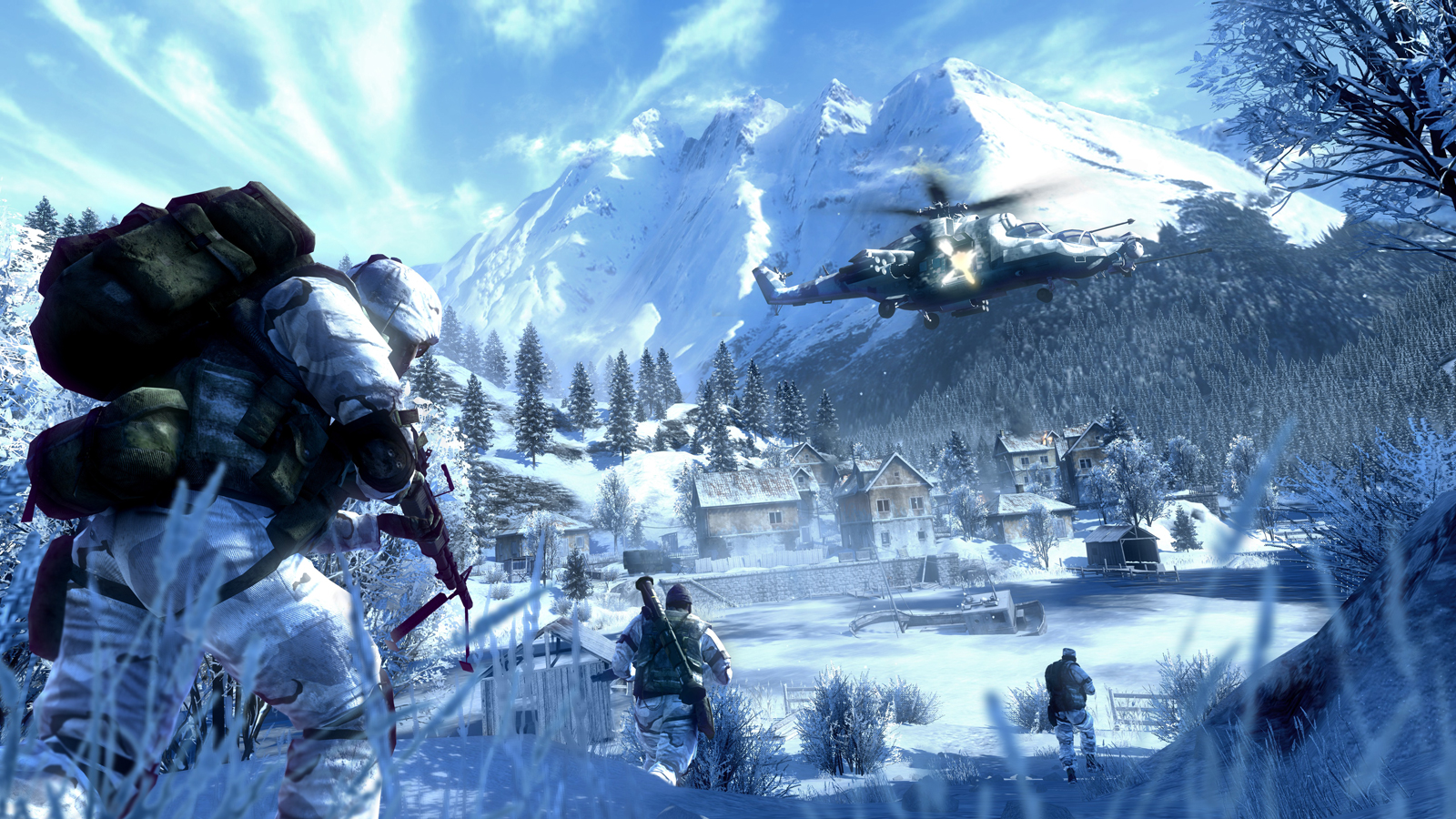
It's safe to say that when you mention military FPS games, Call of Duty is that the forefront of everyone's mind. With that being said, EA has been at this shooter business for quite a while, and developer DICE is known around the world for the amazingly popular Battlefield series. Those that jumped into 1943 on XBLA got a brief taste of what was in store for Bad Company 2, as more destruction, a stronger core online engine, and more customization is in store for the game's second go. While the first Bad Company was a bit touch-and-go overall, my brief time with the game's sequel at TGS 2009 has been anything but, as the game feels great, looks awesome, and plays very, very well.

EA gave the press a chance to try out an all-new level today at its pre-TGS showcase, and from the looks of it the Bad Company 2 is off to a great start. The new desert level mixes some decent elevation changes with two distinct home bases, a mid-level town area (filled with dozens of wrecked vehicles, including halftracks, tanks, technicals, and more), coupled with a beachfront on one side. Using the newly implemented ATVs, players can get a quick jump into the action from the get-go, cruising in at quick speeds to seize the three capture points. Each of the profiles in-game were unfortunately at level one, so we didn't get to see too much customization, but I did have a chance to call in an airstrike on a M1 Abram tank with my sniper class, and blasting people with an AK-47 is always fun.


The level itself was a blast. With the new full-building destruction tanks ruled the field, which in turn caused more counter-tank support classes to easily dispatch the heavy armor. With more support on the field come more snipers, more snipers means more SMG classes and building-leveling tanks, and already you cans see the tug-of-war that occurs. With a map such as this one, the three capture stations acted as three main choke points for the map as well, so action was fierce while spawns were still nice and out of the way. Toss in some choppers and quick-moving ATVs and the action heated up nicely.

As someone who loves on-foot combat as opposed to too much vehicle play, the ATVs were hands-down the highlight of the hands-on time for me. Allowing for a quick start while having virtually no offence, I hopped on using my assault class, would drive directly into hot zones, jump out, and fire away at enemies drawn to the ATV's coasting stop. Those that played Modern Combat on 360 know the awesomeness that comes with triggered explosives and vehicles, and while we didn't have any unlocked for this current game I'm already salivating at the possibilities. Of course there were also a few moments where the ATV screwed me as well, as I'd rip into the city, come face to face with a tank, veer off to the side (with a surprisingly high amount of agility by the vehicle) and then launch into the bay, flooding the engine and forcing me to abandon the vehicle. Still, it was a blast, and for someone that digs jumping into the thick of battle and a more run-n-gun feel the ATV was a great compliment to a more fast-paced "grunt" style of play.

The new destruction engine was also being shown off in full effect, and while we've already touched on the advancements of it in previous hands-on write-ups I personally loved seeing full buildings topple from devastating artillery. Helicopters now own the field even more as well, with barrages of missile fire causing otherwise-sturdy structures to crumble on top of foot soldiers. EA is obviously putting a huge emphasis – larger than normal – on vehicles this time around, with Bad Company housing 15+ in all, but the balance seems to be there, which is great to see.


Speaking on balance, I also seemed to have less trouble dropping enemies in Bad Company 2. One of my main gripes with the first game (outside of too much Gold Rush, and not enough point capturing) was that guns felt just too underpowered. This was not the case with my latest hands-on, and while it still took a few good shots to bring a guy down it was far more realistic, and more effective to be a strong on-foot player as a result. Hopefully this is evidence of huge strides being made in the overall balance department, as Bad Company 2 is outdoing what was started two years ago. This is looking to be a great way to kick off 2010.

We'll have more on Battlefield: Bad Company 2 as the game nears completion. Until then, check out new images direct from TGS in our media gallery below. Bad Company is set to release on March 5, 2010.
READ MORE - Battlefield : Bad Company 2 [preview]
10.19

The Sims 3: World Adventures

1 Comments »
We've had a lot of fun with The Sims 3 since it shipped in early June, and we're not the only ones. According to EA, there have been 3.7 million copies sold since then. The Sims 3 did a bang-up job of widening the scope of the game, giving us the ability to explore entire towns without a single loading screen. That did bring up an interesting question as to how EA would then expand the game, and we got a first look at the newly-revealed The Sims 3: World Adventures to see the expansion pack strategy.

It's sort of difficult to add whole new regions of the existing towns of Sunset Valley and Riverview since they're already so large, so the idea is to create places where your sims can travel to and visit for days or even weeks at a time. (Don't worry, because sims lifetimes are so limited, the designers are making it so your sims essentially don't age while on vacation.) They won't be able to build homes in these new areas (simified versions of Egypt, France, and China), but they will be able to pursue adventures that seem like a further evolution of the franchise. These adventures feature puzzle elements that, upon completion, unlock bigger adventures and more.


Here's how it works. The example we were shown was Egypt, which, as expected, is a desert environment that's filled with simified versions of the Great Pyramids, the Sphinx, and other famous Egyptian landmarks. When your sims go on vacation they are limited in the amount of time they can stay in a region by their visa level; at the earliest levels your visa might last a few days, while at the higher levels it might last a couple of weeks. A high visa level will even let you build a vacation home to stay in, because at the low visa levels you'll be staying in a base camp that's essentially a small tent lot. (Tents will also be in available in Sunset Valley and Riverside, which may means good news to those who like homeless sims.)

At the base camp is a job board that has adventures, which are beefed up versions of the opportunity missions you found in The Sims 3; the more complex adventures might consist of a dozen or more tasks chained together. Completion of these adventures unlocks more challenging adventures, raises your visa level, and so on. An example of these adventures might be exploring tombs, of which there are many in Egypt. These tombs might have diabolical traps that must be circumnavigated or be dealt with. For example, fire traps can be tackled by dousing your sim in water (say by jumping into a small pool) before entering them; the soaked nature of your clothes will protect you. Or you might need to move objects around to activate pressure plates in order to open a secret door. Your sims might dig in rubble for artifacts that can help unlock other doors. Or, you might find all the parts to a rare item and reassemble it, thus giving you a nice trophy for that shelf back home.


Typical, you're making out and someone's mummy interrupts.
You'll also have to search for triggers to reveal hidden doors or stairwells, and this is something that can be used in the regular game when designing houses. That could potentially create all sorts of new adventures in Sunset Valley or Riverview as you could download user-made houses with all sorts of secrets to uncover. Another piece of good news for house designers is a brand-new basement tool that will finally make basement making about a billion times easier than it is currently. With it, you can create basements up to four stories deep that cover the entire breadth of a lot.

Other travel regions will have their own themes. In France it's nectar making, which is the equivalent of wine for The Sims. This involves learning how to cultivate up to eight different kinds of grapes, stomping them into wine, and more. In China, it's martial arts, and there have been all sorts of improvements to the animation system so that the fighting movements are fluid and natural.

While you can't live in these new areas permanently there are many ways you can take them back to Sunset Vally or Riverview. Of course, you might meet foreign sims and marry them. Or there are a new skills and abilities that you can bring back with you, such as nectar making (the sims version of wine). And you might see foreign tourists wandering around your home town taking pictures. That's another new thing, as your sims can now take pictures that you can then mount on your walls, much like the paintings they create.

And this wouldn't be a Sims expansion without a nice, supernatural element. This time around it's mummies from Egypt. These guys (and gals) might come out of a sarcophagus and chase after you. You can get cursed by the mummies, in which you must go to the Sphinx and perform a ritual or else your sim is doomed. You can also become a mummy; the downside to that being that you move very slowly.
READ MORE - The Sims 3: World Adventures
05.06

Elder Scrolls IV: Oblivion

18 Comments »

How much free time do you have? It's a legitimate question if you're considering Bethesda's epic The Elder Scrolls IV: Oblivion, as it's likely to engulf whatever tidbits of unoccupied hours permeate your life. It might even start chipping away your daily responsibilities. With over 200 hours of gameplay, Oblivion's depth is nothing short of staggering. However, depth means nothing if it's paired with crippling bugs or frustrating gameplay. Though Oblivion has a few issues, it thankfully avoids any major blunders, making this the best single player role playing experience to come along in years.

To briefly sum up, Oblivion has no multiplayer. It's an entirely offline role playing game, meaning you'll complete quests, level up and progress through a rich storyline. As you grow more powerful you'll acquire better weapons, armor and spells to kill monsters and, if it's your preference, innocents. Oblivion's four Guilds, Mages, Fighters, Thieves, and Dark Brotherhood all have their own unique questlines and provide opportunity for added perks. Designed to be an open-ended experience, Oblivion's biggest draw is its massive world. Set in Cyrodiil, a province of the larger land of Tamriel, practically everything is accessible right from the start. You can head in any direction you like, playing to beat the story, to complete side quests, or wander around fields, mountains and streams exploring at your own pace.

Though the main quest is usually a game's primary draw, that isn't the case here. The game starts out with the world in danger and you're destined to save it. Pretty standard stuff. The largest threats to Cyrodiil are the Oblivion Gates opening up across the land. Flanked by ominous stone columns, these flaming portals are doorways to hellish dungeon settings where better armor and weapons can be found. Which ones you enter is totally up to you, though some are required by quests. While the story missions are great, there's tons of excellent content you'll be missing if you stick strictly to the main plot. The Guilds, for instance, all have epic storylines of their own. There's a gladiatorial Arena in the Imperial City where you can engage in mortal combat with one, two or even three enemies at a time for cash rewards. It's a wonderfully open-ended game, yet also surprisingly focused once you decide what you want to do.


Anyone who played through the previous The Elder Scrolls game, Morrowind, will remember the almost total lack of direction, a feature which turned many off. While in that game that main quest didn't even begin until around 15 hours after starting, Oblivion kicks off with a major plot development and thrusts you immediately into the main adventure. Once given your initial task to restore order to Cyrodiil and shut down the demonic invasion from Oblivion, you'll never have trouble figuring out what to do next.

This is mostly due to the intuitive map and easy to use quest log. Whenever you accept a task to perform or are assigned a duty, an entry is made in your journal. By clicking on the quest you can see a brief description and set it to "active." Any active quest in your log is highlighted on your map screen with an arrow. Red arrows mean you need to pass through a door, green ones mean you're in the right place, and the arrow also pops up on the compass at the bottom of your screen for extra convenience. Unless you're a total masochist, it's a much welcome improvement, making quest objectives and locations much easier to find.

On top of that, you're given the ability to fast travel around Cyrodiil. Every location in the game pops up as an icon on your map. To be eligible for fast traveling, you need to first visit the location on foot, although the major cities are accessible right from the start. After a location has been made fast travel accessible, you can pop open your map, select it, and arrive there instantaneously. Though time still passes when you travel, you don't have to actually spend it hoofing the journey out. If you'd rather walk, that option is always available, but fast traveling effectively eliminates the tedium of fetch quests so prevalent in the RPG genre. On top of that, it's great for when you want to buy specific spells or armor only available in certain cities. With the improvements to the map, journal and travel system, the world of Tamriel just got a lot more user friendly.

These improvements make Oblivion a great title for anyone still wary about RPGs. Though the depth and gameplay options may be daunting, there's always plenty of information available to tell you how to go about getting things done. Of course, the goal of any game is to make your character an utterly unstoppable force, capable of destroying friend and foe alike with the mere twitch of an eyelash. To become an unconquerable world dominator in Oblivion, there's a mind boggling array of options.

Before doing anything, you need to create your character. Bethesda has implemented a great creation feature, allowing you to meticulously customize your character's appearance and class. Whether you play as a reptilian Argonian, stout Orc or sneaky Wood Elf, you'll be able to adjust skin tone, facial structure, hair styles, eye color and many other options. When moving through the initial sewer area, you'll also choose a class, which can be completely customized should you wish to do so. We could list all the options available, or we could tell you that it's entirely possible to create a thief-mage High Elf with albino skin and bruised eyes, a penchant for haggling with item vendors and nasty accuracy with a bow. What this all means is Oblivion lets you create as fined tuned and personalized a character as you could possibly want.

Despite the range of options, some of the skills and attributes are useless given the effectiveness of others. For instance, Luck is a terrible attribute to choose for one of your two primaries, since it doesn't directly affect anything. A few of the skills, such as acrobatics and athletics, are useless as well as one of your seven main. The way your character levels up is through use of skills, not experience. The more Destruction spells you cast, the more monsters you conjure, the more you heal yourself, the higher those skills rise. Once your skills bump up enough, you level up and can increase attributes. Since you're going to be running and jumping (athletics and acrobatics) constantly regardless, there's no need to build those into your main attributes.

If you do pick a few useless skills, you're going to know it a few levels down the road and likely want to change them. Once you're outside the first dungeon, however, you can't change your character. So read all the information provided by the game and choose whatever you feel best. Yes, it's going to require thinking. If that prospect turns you off, then this game probably isn't for you. Better yet, make a game save right before leaving the initial dungeon you can reload should you be unsatisfied with your character choice. In fact, save about every five minutes. Since you'll never be sure how powerful an enemy is going to be, the chance of a brutal death is always high when trekking across Cyrodiil. Having a recent save is a requirement, otherwise you could find yourself losing hours and hours of progress. Though the game will auto-save, it's a better idea to have a hard save available, since the auto-save always overwrites itself.

Once outside the initial dungeon, you'll start to understand just how massive Oblivion's world really is. Opportunities for new quests and stories are everywhere, and there's no pressure as to which path you should follow. Thanks to the map, journal and fast travel system, it's way easier to follow a path once you pick one. Throughout each of Cyrodiil's towns you'll find nearly everyone has something they need done, and each task has a story behind it. Though many quests turn out to be standard dungeon crawls, there's usually a twist or turn along the way. For instance, buying a house at a discounted price in Anvil seems like a great deal. That is, until you actually sleep there and get attacked by ghosts. Upon investigation, you discover there's the corpse of a long-dead Necromancer haunting the crap out of your basement, and he's still pissed off. This kind of attention to detail is present in many of the game's bevy of quests.

Interacting with people around Cyrodiil is surprisingly realistic, and Bethesda's much-hyped Radiant A.I. system works well. NPCs engage in random conversation from which you can glean quests should you eavesdrop at an opportune time. We witnessed one branch of the fighter's guild sit down to eat dinner in unison. NPCs will take naps, engage in everyday activities, and occupy themselves with swordplay or spellcasting for fun. Some of the random conversations still sound stilted and unnatural, starting off with lines like, "Hey, so how about that that local Mages Guild." It's basically water cooler talk, but it's interesting nonetheless. Sometimes, you'll overhear more intriguing topics, like one NPC hitting on another.

Actually engaging NPCs in conversation is absolutely impressive, as each character in the game has spoken dialogue. Considering the titanic amount of NPCs in the game, that's a lot of spoken dialogue. Though in many cases they're just canned responses using a repeated voice (every Argonian female sounds pretty much the same), there's always some unique samples for every quest. Whether the NPC is pouring their heart out to you because they need help or detailing an intricate history of a specific item, it's all voiced, though not free of occasional excessive cheesiness.

There's also an engaging persuasion system in place in case an NPC won't give you the information you're looking for. Like the rest of Oblivion, there's multiple ways to get them to see your side of things. Depending on the kind of character you're playing, you can use speech skills to charm them, use a charm spell or just toss some money their way. Rewards from doing so include getting information necessary for quests, and gaining an NPC's trust so you can buy a house, among other things. So, the system isn't there for the sake of its own existence, it serves a function which at times can be very beneficial.

Once out in Cyrodiil's wilderness, these persuasion skills become much less relevant. You'll instead need to rely heavily on your combat skills. One criticism of The Elder Scrolls since its beginnings has been awkward combat, and that remains true here. Oblivion's fighting mechanics are much improved and interactive over previous versions, but still not perfect. You're able to block and swing with separate buttons and have another for casting spells. Blocking can knock enemies off balance for free swings, but also do the same to you, so the fighting is no longer a mindless procedure of hitting attack ad nauseum; you'll actually need to pay attention and properly time your swings, blocks and casts. In one-on-one situations, these controls function well but run into problems in confined areas or in group battles.

A good strategy in Oblivion is to lure all opponents to an open area, allowing you to move around. While you don't need pinpoint accuracy to attack effectively, you do need to be facing the general direction of your opponent. In tight quarters, the dizzying effects from getting smashed by swords and maces make proper aim overly difficult. While in open spaces you could recover by backing up, you're pretty much stuck in many of the smaller cave tunnels. This problem intensifies when in group battles, especially with friendly NPCs. Since getting struck occasionally makes you wobble, you'll have a difficult time discerning who you're slashing at in a group melee. Given the fact that friendly NPCs will actually start attacking you should they take enough damage from your weapon, it's important that you're targeting the right person.

During the confusion of battle, you'll need all your important spells and weapons readily available. Enter Oblivion's hotkey system, which allows up to eight items from your inventory to be accessed without returning to your menu screen. It's a wonder the system was limited to only eight, given the depth of the rest of the game. There are literally hundred of icons to choose from, be it items, weapons, spells and armor. Trying to limit that to eight is a little extreme, especially considering the range of situations you can find yourself in. Why not implement a system where you can switch between multiple hot key sets? That way, you've got a hotkey set for magic, one for combat, one for fighting undead, one for marksman, etc. As it stands, you'll have to constantly switch appropriate icons in and out of hotkey assignments, which is more of a hassle than it should be.

For PC users, the hotkeys are conveniently mapped on your keyboard, but Xbox 360 owners will be faced with a more annoying control setup. The D-Pad's vertical and horizontal directions work fine, but the icons you assign to the diagonals will prove difficult to select with any sort of regularity. You'll often find yourself mistakenly switching to a healing spell when you meant to pull out a shield and sword, or siphoning health when you meant to summon a Frost Atronarch. Combine this with the imprecision during battles with multiple foes or in close quarters, and you'll find combat in Oblivion requires a little more patience that you might have expected.


Despite those issues, the rest of The Elder Scrolls IV controls very well. Basically it just comes down to whether you prefer a mouse or a thumbstick. Though the game offers a third-person mode, don't bother using it save for checking out your armor. It's nearly impossible to fight with the camera pulled back, and some of the third person animations look unrealistically silly (sideways moonwalk anyone?). All in all, the Oblivion functions better than it did in Morrowind, but there's still room to improve.

Though you'll spend a lot of time fighting in Oblivion, you'll also spend a good deal of it just wandering around. Mostly, this will be an unconscious result of Oblivion looking absolutely fantastic. Environments sprawl for great distances in front of you, trees and grass sway to and fro, and the lighting and level of detail in the sky can be breathtaking at times. The environments look so good, it's nearly impossible to resist the urge to plunge into the unknown. Weapon and armor models are intricately detailed, towns have their own unique architectural flair, and though some of the dungeon designs may get repetitive, they're always pretty to observe.

Character and enemy models are highly detailed, though some of the NPCs have odd facial features and questionable speech syncing. Creature animations are generally very good, and the physics system embedded in each model can produce some impressive results at times. For instance, a conjured Daedroth can effortlessly smash an enemy several feet through the air on a killing blow. Downed wolves roll down hills, and enemies can be blasted right out of midair with a well placed magic blast.

Unfortunately, the graphics aren't without their faults. Though you can see extremely far into the distance, far off hills will be blanketed in low resolution textures that otherwise mar a beautiful scene. Loading times may also be a bother. Not the loading times when entering doors or fast traveling around the world, those are entirely manageable. It's the loading that occurs when traveling across the land that will cause the Xbox 360 version to stutter, as well as any mid to lower end PC. The game needs to load in grass and environmental objects at regular intervals, and the ensuing pause in the action may turn some off. There's also a very visible amount of pop-in, as grass, rocks and even houses appear at the edges of your vision.

This loading setup was obviously implemented to keep framerates manageable. For the most part, it's excusable considering the stunning graphical heights Oblivion is able to reach in other places. Still, the loading stutter may bother you and the framerate as well. While the game runs at a steady clip in dungeons and indoors, you'll notice a performance hit when traveling quickly through outdoor areas and in crowded towns. These framerate drops don't so much affect the gameplay, but remain an annoyance as it takes you out of the experience. On high end PCs these framerate and loading issues are diminished, but most PC and all Xbox 360 gamers will have to put up with them to enjoy the otherwise visual delight that is The Elder Scrolls IV.

While wandering and wondering at Oblivion's visual prowess, your ears will be equally entertained. As previously stated, the game is packed with an amazing amount of spoken dialogue, for the most part well acted. The musical score is excellent and fitting for the game's medieval fantasy setting. Depending on the environment, you'll get cheery daytime adventure type of compositions, tense battle music, and ambient, unsettling string arrangements for dungeons and ruins. Sound effects are equally impressive, with crisp metal clangs for clashes in battle and eerie, otherworldly audio for magical happenings. Wraiths and ghosts boast unearthly wails and residents of the Oblivion plane bellow in deep, hell-tinted cadences.

With a game this gigantic, you're going to have to expect some bugs. Morrowind had quite a few, some relatively serious, specifically with the Xbox version's "fall through the world" bug. Thankfully, Oblivion has so far proven to be a more stable product. That being said, if you play this game, you'll likely encounter crashes. Bugs include the PC version crashing to desktop and freezes during loading screens on the Xbox 360. When we first popped in our Oblivion disc it has absolutely painful loading times, but they went away the second time we fired the game up and haven't returned since. Other bugs include monsters and NPCs disappearing, clipping through walls, and strange sound glitches. Do the bugs make the game unplayable? Absolutely not. Sure, they're annoying, but they don't break the game. The sheer amount of content and breadth of gameplay options that went into this title outweighs any minor gripes that can be made about errors that crop up here and there.

Closing Comments
I've done enough blabbering and hairsplitting. Is the Elder Scrolls IV worth a purchase? Definitely. If you checked the Xbox 360 page, you'll notice it got the same score as this version. If you're an RPG fan, it's an incredible experience. If you regularly beat RPG fans with hockey sticks, you should still try this one out. It's got combat issues, the hotkey system could have been implemented better and some may be ticked off by the environmental loading stutters. Also, keep in mind your loading times aren't going to be seamlessly smooth unless you're playing on a high-end rig. For most gamers with mid-range PCs, you're going to experience hitches. PC gamers get the benefit of the Elder Scrolls IV Construction Set, a big asset for modders looking to expand their Oblivion experience beyond the scope of what Bethesda envisioned. Let it be said, the PC version has advantages. However, because of the PC market's RPG competition, the score remains what the same as Oblivion on the Xbox 360. Despite any criticisms, Oblivion remains a thoroughly enjoyable, user-friendly, gorgeous experience with enough content to keep you returning time and time again.
Another Take
from Tom McNamara
Once upon a time, I bought the Collector's Edition of Daggerfall and wandered through its operatically enormous landscape for untold hours. I played and finished Morrowind and its expansions. ES4 was my most anticipated release since Half-Life 2, and it doesn't disappoint. While I don't think Lynda Carter's voice acting is that great, this aspect of the game is otherwise uniformly excellent and star-studded -- a refreshing change from the B-list hell us RPG geeks are often stuck with. And it's all voice acted; apparently over half the disk is dialog. The music is also memorable, yet it doesn't get tedious after many hours of playtime (I passed the 25-hour mark last night). The ambient material in the dungeons is awesome.

I've finished the Thieves Guild quest line, gotten to Conjurer in the Mages Guild, but I've only done a few quests in the main storyline. Unlike most other RPGs, the "side quests" have nearly enough content and narrative continuity to be games in their own right. Each of the main organizations -- the mages, thieves, fighters guild, Dark Brotherhood, et cetera -- has its own drama to unravel, and you're rewarded with some pretty cool loot along the way. There's so much content, in both the cities and the countryside, that I'm astonished Bethesda was able to put this thing together in a reasonable amount of time.

But it’s not all wine and roses. There is a certain quest in the main storyline that simply must be done early on. It appears to be hard-coded for a large amount of NPC (non-player character) assistance, as you'll encounter a much larger amount of monsters than usual. The monsters of Oblivion dynamically progress to match your character level, giving you a challenge no matter where you are in the game world, but your NPC assistance appears to remain static. So quests that require this assistance can be extremely difficult if you wait too long to get to them. Those helpers who were wearing iron or steel armor will still be doing so 20 levels later, whereas the enemy will have some pretty nice gear. It gets ugly. You can also level up with non-combat abilities and get your butt handed to you, since the game appears to only check your character level, not your combat proficiencies, when auto-adjusting. And a spellcaster won't have much in the way of roots or snares, making for a lot of backpedaling during combat.

Also, I find the Invisibility spell to actually be too powerful. Not only does a monster completely lose track of you, but you can even bump into them and push them out of your way. You can cover a ton of ground without getting in a single fight. The spell can last up to 60 seconds with a manageable mana cost, and it can be recast ad infinitum. There's no WoW-style cooldown, or diminishing returns (such as monster resistance). The behavior is flat and its effects total. Once I got this spell, I sailed through the latter half of the Thieves Guild quest line.


But while Oblivion certainly has its quirks, it's still very compelling and engrossing. It's also a ton more stable than I'm used to with Elder Scrolls games. Character creation is a little complex for the ES initiate, and the town guard AI a little physic when I "borrow" something, but I was hooked after going through that first big mission in the main storyline, and I think most RPG gamers will be as well.
READ MORE - Elder Scrolls IV: Oblivion
21.29

Burnout Paradise [review]

0 Comments »
Burnout franchise has now long been the king of arcade racing. Its tight controls and overwhelming sense of speed have catapulted it to the top of the genre, and few games have come even close to matching the series' strengths. But while Criterion has garnered tons of praise from both gamers and critics alike, the studio never sits still. With every release, the developer tweaks the core formula in an attempt to offer something new to gamers.

Burnout Paradise sees what are arguably the biggest changes in the franchise's history, with nearly every single aspect of the game having seen some sort of shift in design. Some of it works really well, and some of it not so well, but what we wind up with still remains an intense, blazingly fast and perfectly controlling racer, one that you shouldn't miss.


The biggest change introduced in Burnout Paradise is the move to an open world, the streets of Paradise City (cue Guns 'N' Roses title track). The entire city is open at the start of the game, with the idea being that you can do whatever you want, whenever you want. Not all of the events are present at the start, mind you, and you'll have to put in a lot of time to unlock the game's roughly 75 cars, but you're never limited in the options before you.

There are bits of good and bad to this. The good is that the city design is great, offering up plenty of varying spots for you to race in and tons of hidden areas to find. There is no shortage of tucked away passages, underground runs and all sorts of cool spots to hit. You'll find jumps littered everywhere, including small ramps with kickers on the side to send you into a barrel roll, which are great for the Stunt runs (which we'll come back to in a bit).

The main downtown area of Paradise City is very reminiscent of the downtown tracks in the last couple games, while the western section of the city harkens back to the long, winding, countryside courses of past games as well. A couple of highways will put you dead in the middle of traffic and give you plenty of road to get up to speed on.

The car designs are fantastic.
Paradise City is very dense, especially the eastern, downtown section, offering you a myriad of ways to get through a race. When a race starts, you simply must race from point A to point B as fast as you can, along whatever route you want. While this means that you're given the freedom to create your own course, it also means that you'll be stopping the action and referring to the map fairly often to make sure that you don't take any wrong turns. Since there are so many different tunnels, highways and such to take, it can be easy to make a wrong turn and wind up going off course for a bit. Until you've memorized the bulk of the map, which given its complexity, will take quite a long time, you'll likely have to pause and check the map two or three times during a race to make sure that you're on the right path.


There's an in-game indicator of where the finish line is, but it just points in the compass direction and doesn't help with turns or anything of that sort. This is understandable to a degree since Criterion (rightfully so) wants you to create your own routes and not rely on what it thinks you should do, but it does mean that you'll be at the mercy of the pause screen until memory starts taking over.

Another downside to the overall design of the open world setup is that you cannot simply pause and restart an event. This means that if you race from one side of the map to the other, which you will often do, you'll need to turn around and drive all the way back to the starting point to try again if you lose. While this sounds, and can be, annoying, changing the way that you approach the game helps to overcome this for the most part. Knowing that this was the case, instead of trying to perfect every event as we went along, like we've done in the past, we instead tried an event and, regardless of the outcome, just tried something else nearby when it was over. Playing this way makes for a much more organic experience and will help greatly in lessening the annoyance of not being able to quickly restart, though if you're aiming for a 100% completion rating then you will inevitably have to drive back to the starting line when you're down to the last few events in the game.

Of course, races aren't the only event type to be found in Paradise City. Of everything in the game, it's perhaps Road Rage that has seen the smallest amount of change, which is perfectly fine by us. The only major difference this time around is that instead of having three target cars at any one time, you'll now have five or six at a time to take down. It's a small change, but Road Rage is even more chaotic now because of it as you'll see more cars than ever before crashing in front of you and flying over your windshield. We still can't get enough of it.


The Crash mode of old is essentially gone, replaced by Showtime events. Rather than racing up to a streetlight and spinning your wheels to begin it like most every other event, Showtime can be started at any time (even as you're already crashing) by hitting two shoulder buttons. Your car will immediately begin flipping and you'll start racking up a score for the street that you started the Showtime on. While the street that you begin the event on is where your score will apply to, you can actually flip and crash across the entirety of Paradise City if you're good enough.


There are major differences between Showtime and the Crash events of old, however. You can keep your crash going so long as you keep moving, which you can prolong by bouncing your car if you have some boost. Boost is earned every time you hit a car, which also increases your score, of course. However, you only earn points for cars that you actually hit, not those that crash around you, and you only earn multipliers for hitting busses. The bus-only multiplier thing is disappointing because you can go for 10 minutes without seeing a bus during one Showtime, but start another and hit a handful right away, thereby giving you exponentially more points simply because of randomized luck.

Regardless of that, there isn't a whole lot of skill involved in the Showtimes, aside from seeing how absurdly long you can keep it going. But the required scores are easy as pie to hit, and since there's no planning or anything involved in what you're doing, it feels like most of the challenge (and thereby fun) of the old Crash modes is gone.

Road Rage is largely the same, but it's still the best incarnation yet.
Showtime events are coupled with timed runs for each street. If you head to one of the ends of any road in the game and start driving on it, a counter will begin ticking up that shows you your time. It's a very simple and very natural way of including time trials in the game, and as simple as it is, it works really well.


Stunt events are the freshest addition to the Burnout formula, tasking you to rack up a certain amount of points in a given timeframe. While you'll earn points for sliding around turns and boosting, you'll only earn valuable multipliers for jumping off ramps, crashing through gates or performing a barrel roll, which gives you double goodness. It's a pretty awesome event that'll have you screaming down streets, looking for just one more ramp to hit to help keep your combo alive. The only downside here has to do with the different types of cars you can choose and how they affect a Stunt event's difficulty Each of the 70+ cars in the game falls into a certain category, either Stunt, Speed or Aggression. The Aggression vehicles are large and heavy, perfect for Road Rage, but not so much for events that require agility. Cars with the Stunt classification are designed to be good for jumps and drifting, and most resemble the rides that you'll find in past Burnout games. Speed cars specialize in excessive boosting as they allow you to chain together Burnouts to keep your boost going forever, but they have a downside in that you can only start a boost when your meter is full.

Having to wait until your boost meter is full means that the Speed cars are more finicky during races, though the payoff on long straightaways can be greater. But during Stunt events they wind up being terrible picks since a quick tap of the Boost in any other vehicle will immediately extend your combo meter. In a Stunt or Aggression car, you can take a jump for points, cruise for a bit while looking for your next jump, and then tap the boost for just a second when your combo is about to expire to extend it. Not so in the Speed cars. This boosting difference would make more sense if the Speed cars were noticeably faster than the other types, but they're not.


One pretty cool thing relating to the vehicles in the game is how you earn them. When you get a new license, you'll be rewarded with a new ride in your junkyard for driving immediately. All of the other cars, however, have to be taken down first. When you "unlock" a car after an event, it will then appear somewhere in Paradise City and drive around on its own. In order to fully earn it, you have to find said car and then take it down. Like our approach to event selection, we found this to be best when we didn't bother hunting them down after unlocking them, but instead kept doing our thing while keeping our eyes peeled. Then when a car crossed our path, we'd drop everything and head out with a new ride in our headlights. It's a pretty awesome mechanic that helps instill life into Paradise City.

Perhaps the most well-implemented addition to the franchise is the way that online play works. Instead of having to jump out to a separate menu to get online, invite friends to your game, set up challenges or whatever else, all of this is manageable in-game with the D-Pad. Pressing right on the D-Pad opens up the online menu where you can then hop online, invite friends to your game, set up race events or whatever else you want, all while your engine is still running.

When a friend or two (or seven) hop on, you have a number of options. You can create a custom race where you can set start and end points and drop any number of checkpoints onto the map. You can even save these routes for play later on so that you don't have to keep making them. You can also start a Freeburn Challenge of some sort. There are 50 challenges for each number of players in the game. In other words, there are 50 challenges for two player, 50 different challenges for three players, and so on and so forth, giving you an absolute ton of Freeburn runs to complete (yes, 100% completion will take a long time). These are as simple as having two players race from opposite sides of an open bridge and crashing in mid-air to having every player do a barrel roll through a hoop. They're all good fun and give you tons of different things to do.

Speed, speed and more speed. Oh, and some extra speed for flavor.
Regardless of everything we've talked about, the most important part of any Burnout game, and the reason they've been so successful in the past, is simply how well (and fast) the driving mechanics work. Criterion has nailed the formula once again, offering gamers the pinnacle of arcade racing mechanics with cars that control exactly how you would expect them to, with the perfect amount of inferred weight sent to the player. As well, the sense of speed we've seen in the past is here 110%, with roadside objects blurring by your outside mirrors at uncountable speeds.

Lastly, it's worth mentioning that Criterion has also once again delivered a game that runs incredibly smooth and sounds fantastic. The game runs at a blistering 60fps, which ties perfectly with its controls, and it looks impressive at that. The crash effects are fantastic, slowing down to show you your crumpling wreck as the steering wheel is shoved into the driver's seat. Were there a virtual driver sitting there, he'd be dead.
READ MORE - Burnout Paradise [review]